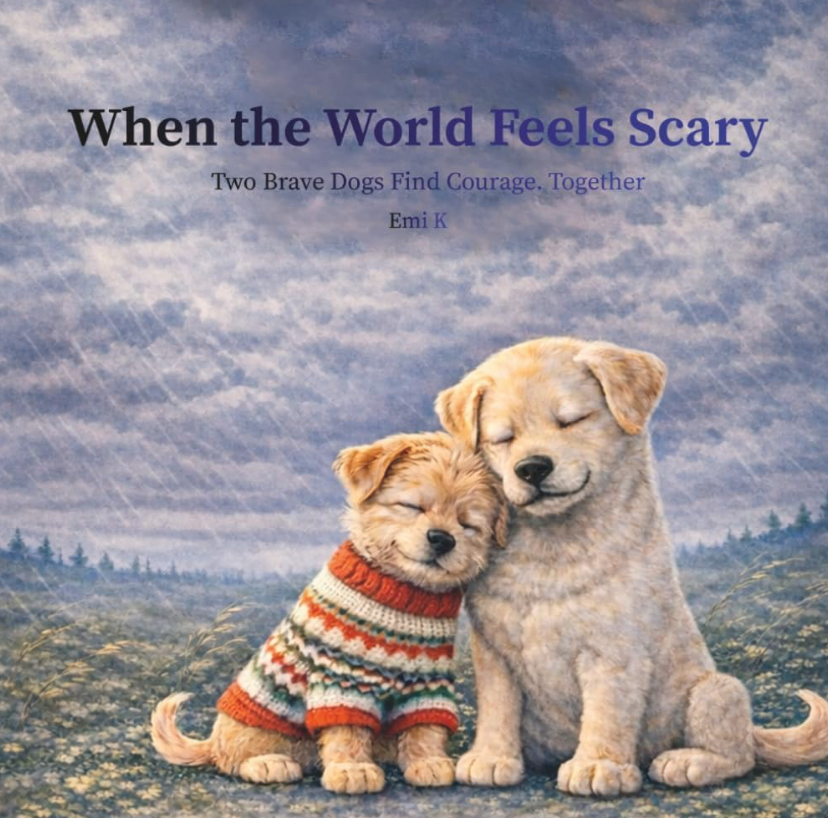
Why a Licensed Therapist Writes Children's Books — And Why It Matters for Your Child
Most children's books about feelings are written by authors who love children. That matters. But Emi K writes from somewhere different: years of clinical practice as a Licensed Clinical Social Worker (LCSW-C), sitting with children and families in the middle of hard things. The credential isn't a marketing badge — it's a lens that changes every word on every page.
This post explains what LCSW-C means, why it matters in children's content specifically, and what parents and educators can expect from books built on clinical training rather than good intentions alone.
What LCSW-C Means — and Why It's Not Just a Certification
LCSW stands for Licensed Clinical Social Worker. The "C" designation — used in Maryland and several other states — specifies clinical licensure, meaning the holder is authorized to diagnose mental health conditions and provide psychotherapy independently.
To earn an LCSW-C, a candidate must:
- Complete a Master of Social Work (MSW) degree from an accredited program
- Accumulate a minimum of 3,000 hours of supervised clinical experience post-graduation
- Pass a national clinical licensing examination administered by the Association of Social Work Boards (ASWB)
- Meet ongoing continuing education requirements for license renewal
This is not a weekend workshop or an online certification. It is a multi-year, rigorously supervised clinical training pathway that qualifies a professional to work with children, adults, and families at the highest level of complexity — trauma, grief, anxiety disorders, family systems disruption, and more.
Emi K brings this training to every book she writes. The result is children's literature that functions as more than a story — it's a clinical tool in picture-book form.
How Clinical Training Changes the Storytelling
Most adults who write children's books about emotions approach it intuitively: they remember what it felt like to be a child, they observe children they know, and they try to capture something true. That approach produces many wonderful books. But it also produces books that are subtly off — books that accidentally shame children for their feelings, or skip straight to coping strategies before the emotion has been acknowledged, or frame complex experiences (like grief, anxiety, or family transitions) in ways that aren't developmentally accurate.
Clinical training does something different. It provides a framework for understanding how children actually develop emotionally — and how to write for that development.
Emotional Accuracy Comes First
In therapeutic practice, the first principle is validation: a child's feeling must be acknowledged and named before any intervention is offered. "You felt angry" before "here's what to do with anger." This sequencing isn't stylistic — it's neurobiological. A child whose emotion is validated first is able to engage with coping tools. A child who is handed a strategy before being heard is likely to reject it.
Every book in Emi K's catalog is structured with this principle. Emotions are met first, held first, normalized first. The coping strategies — when they appear — come as a natural next step from a place of safety, not as a correction to the child's experience.
Realistic Coping Strategies, Not Platitudes
Generic children's books about anxiety often offer strategies like "take a deep breath" or "think happy thoughts." These aren't wrong — but they're incomplete. A child in the grip of a real anxiety response may not be able to access breath work in the moment. A child who has been told to "think positive" when they're grieving often ends up feeling more ashamed, not less anxious.
Clinical training produces a richer toolkit. Emi K's books draw on approaches used in evidence-based therapies — including cognitive-behavioral therapy (CBT), play therapy, and attachment-informed practice — translated into language and images that a three-year-old can absorb. Strategies in these books are clinically tested, developmentally calibrated, and honest about what big feelings actually feel like in a child's body and mind.
Age-Appropriate Framing of Complex Realities
Children's books about family separation, grief, immigration, anxiety, and belonging require an understanding of how children at different developmental stages conceptualize these experiences. A four-year-old's understanding of death is categorically different from an eight-year-old's. A child experiencing parental separation will be egocentric in ways that are completely normal — and books that don't account for this (by, for example, implying children "understand" why parents divorce) miss their audience entirely.
LCSW-C training includes developmental psychology, family systems theory, and child psychopathology. Emi K doesn't need to guess how a child experiences a new sibling or a parent's mental illness or the fear of being left behind — she was trained to understand it, and has worked with children navigating exactly these realities.
What Generic Books Miss — and What Clinical Books Get Right
This isn't a criticism of all non-clinical children's books. Many are beautifully written and genuinely helpful. But there are consistent patterns that distinguish books written from clinical training from books written without it:
| Generic Books Often… | Clinically Informed Books… |
|---|---|
| Offer strategies before validating the feeling | Validate the feeling first, always |
| Inadvertently shame children for "bad" emotions | Explicitly normalize the full spectrum of emotion |
| Present coping as simple and immediate | Acknowledge that big feelings take time to move through |
| Simplify complex family situations (divorce, death, immigration) | Hold complexity without false resolution |
| Write to an idealized "average" child | Write for the specific emotional experience being addressed |
| End with a lesson or moral | End with the child's felt sense of safety and capacity |
The difference isn't always visible in a single page. It accumulates across a book — in the sequencing, the word choices, what's said versus what's not said, and especially in how the child character is treated throughout the story.
The "Feelings Playbook" Approach
One of the concepts that shapes Emi K's work is the idea of building a child's internal "feelings playbook" — a personal library of emotional experiences they've worked through, strategies they've tried, and evidence they've accumulated that big feelings are survivable and manageable.
Therapeutic work with children often focuses on exactly this: not eliminating difficult emotions (which is impossible), but building the child's confidence in their own capacity to move through difficulty. "I've felt scared before, and I was okay." "I know what to do when my stomach feels tight." "My feelings are real and they don't last forever."
Each of Emi K's books is designed to add a page to a child's playbook. The Little Hearts, Big Skills series specifically is built around this framework — each title addressing a distinct emotional domain and leaving children with a concrete sense of how to navigate it.
This is not accidental structure. It is clinical intentionality translated into picture-book form.
About Emi K, LCSW-C
Emi K is a Licensed Clinical Social Worker (LCSW-C) and author of 26 therapeutic children's picture books. Her clinical background includes work with children, adolescents, and families across a range of emotional and developmental challenges, including anxiety, grief, family transitions, social skills development, and early childhood mental health.
Her books are used by parents, school counselors, therapists, pediatricians, and librarians who want children's literature that is both emotionally honest and clinically grounded. She is the author of the Little Hearts, Big Skills series, the When the World Feels series, and several other collections organized by emotional theme and developmental stage.
Browse the full catalog or visit the For Librarians page for collection development resources, including theme-organized book lists and ordering information.
What This Means for the Child in Your Life
When you hand a child a book written by a licensed clinical social worker, you are handing them something that has been shaped by thousands of hours of listening to children. Every word has been filtered through the question: will this actually help a child? Will this reach a child who is struggling? Will this make a child feel more seen, more capable, and more confident in their own emotional life?
That's the difference the LCSW-C credential makes. Not that the books are better-written (though we believe they are). But that they are written from inside the experience of supporting children through exactly the things the books address.
For parents raising emotionally aware children: browse books by your child's age to find the titles most relevant for where they are right now.
For teachers and counselors building classroom libraries: the For Teachers and Counselors page has the full collection organized by SEL theme.
For librarians building therapeutic collections: the For Librarians page has collection development resources and direct ordering information.
Get the free Feelings Talk Starter Guide — 10 conversation prompts to help children name big emotions, written by Emi K, LCSW-C. Download it free here →
Subscribe to The Reading Nook newsletter for monthly recommendations of clinically grounded children's books for the big feelings in your child's life.